 playtua
Dots and Boxes Strategy Guide — Win Every Game With These Pro Tips
Master Dots and Boxes with advanced strategies! Learn chain control, sacrifice plays, and endgame tactics to dominate this classic two-player game. Explore the topic in detail, discover related games and follow the links to keep learning. Whether you are choosing your next game or returning to a favourite, use this story as a starting point for a more enjoyable round.


Dots and Boxes looks like a children's game — connect dots, complete boxes, most boxes wins. But beneath this simple exterior lies one of the deepest two-player strategy games ever designed. Mathematicians have studied it extensively, and the strategy involves concepts from combinatorial game theory.
Here's how to go from casual player to someone who wins almost every game.
The Basics
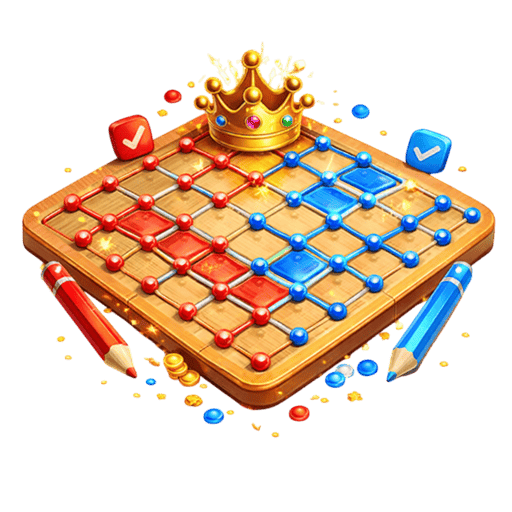
Two players take turns drawing a single horizontal or vertical line between adjacent dots on a grid. When a player completes the fourth side of a box, they claim that box and take another turn. The player with the most boxes when all lines are drawn wins.
The critical rule: when you complete a box, you get an extra turn. This creates chain reactions where completing one box forces you into completing the next.
Beginner Strategy: The Third-Side Rule
The most important beginner principle: never draw the third side of any box unless you're forced to.
You can play this game for free on Android and iOS — no ads, no purchases required.
Why? When a box has three sides, your opponent will draw the fourth side, claim the box, and get a free turn. You're essentially giving them a point.
Practice this: Before drawing any line, scan the board for boxes with exactly two sides completed. Drawing near those boxes is safe. Drawing a line that creates a third side is almost always a mistake.
Intermediate Strategy: The Sacrifice
Sometimes you must give your opponent a box. When this happens, sacrifice strategically:
Give away the smallest possible group of boxes
Preferably sacrifice exactly 2 boxes in a short chain
This forces your opponent to "open" a longer chain for you
The sacrifice play is counter-intuitive — voluntarily giving away points to gain a larger advantage. But it's the foundation of advanced Dots and Boxes play.
The Double-Cross
The most important intermediate technique. When your opponent gives you a chain of boxes:
Claim all boxes in the chain except the last two
Complete the second-to-last box by drawing its third side (not fourth)
Your opponent is forced to take those last 2 boxes
But now they must open the next chain for you
This "double-cross" lets you control who opens each chain. The player who controls chain openings controls the game.
Advanced Strategy: Chain Parity
At the expert level, Dots and Boxes is entirely about chain parity — whether the total number of chains on the board is odd or even.
What Is a Chain?
A chain is a sequence of connected boxes where completing one leads to completing the next. Chains can be:
Short chains: 1-2 boxes (sacrificeable)
Long chains: 3+ boxes (valuable)
The Parity Rule
If the number of long chains is odd, the player who moves first in the chain phase wins
If the number of long chains is even, the second player in the chain phase wins
Advanced players manipulate the board during the early and middle game to create favorable chain parity for the endgame.
Game Phase Strategies
Opening (First 30% of Lines)
Draw lines in the board interior, away from edges
Avoid creating third sides
Focus on maintaining flexibility
Count potential chains forming
Middle Game (30-70% of Lines)
Begin identifying chain structures
Make sacrifice decisions — which small chains to concede
Manipulate chain parity through strategic line placement
Force your opponent into unfavorable positions
Endgame (Last 30% of Lines)
Execute double-cross technique on every chain
Claim long chains while forcing opponent to open the next
Count boxes carefully — sometimes taking a shorter chain is optimal if it gives you parity control
Common Mistakes
Mistake 1: Greedily Taking Every Box
Taking every available box feels good but often loses the game. The double-cross sacrifice of 2 boxes can win you 10.
Mistake 2: Random Line Placement
Every line should be intentional. Random lines in the early game create uncontrollable chain structures that favor your opponent.
Mistake 3: Ignoring Chain Formation
By the middle game, you should be tracking chain structures. Ignoring them means the endgame is decided by luck rather than skill.
Mistake 4: Playing Too Fast
Dots and Boxes rewards careful thought. Take 10-15 seconds per move to assess the impact of each line on chain parity and box completion.
Mistake 5: Fear of Sacrifice
New players avoid giving away any boxes. Experienced players know that controlled sacrifice is the path to winning more boxes overall.
Grid Size and Strategy Depth
Larger grids create more chains and more opportunities for strategic manipulation. Start with 3×3 to learn, then progress to 5×5 for the full strategic experience.
See the full game collection or learn about Playtua's features.
Keep Reading
Related Strategy Games
Tic Tac Toe — Fundamental strategic thinking
Ludo King — Strategy mixed with probability
Connect Em All — Spatial constraint puzzles
2048 — Multi-step strategic planning
📱 Download Playtua — App Store · Google Play — Play Dots and Boxes free against AI or pass-and-play with friends.
Featured Games
FAQ
What is the best opening strategy in Dots and Boxes?
How do chains work in Dots and Boxes?
More Articles
Download Playtua Free
50+ native 3D games, minimal ads, works offline. Go ad-free with Premium!
Download NowLearn a game from its own guide.
After “Dots and Boxes Strategy Guide — Win Every Game With These Pro Tips”, explore the game guides and collections behind the stories. The dedicated game guides explain objectives, touch controls and practical tips in one place. Use them alongside the articles when you want the details for a particular game.
Penguin Run guide
Learn lane changes, jumping and sliding, then follow the goal of reaching the end of the jungle track.
ExploreBlock Blast guide
Understand block placement, line clearing and the space you need to keep open for the next shape.
ExploreCar Racing guide
Read the steering controls and learn how traffic, speed and the finish-line objective fit together.
ExploreFind a collection for your next break.
Collections group games around a style of session, from a few spare minutes to a longer offline journey. Their descriptions help you compare ideas without committing to a particular genre.
Quick-break games
Discover picks for a spare moment, with clear objectives and a range of controls and challenge levels.
ExploreOffline travel
Explore games for journeys and places where a reliable connection may be unavailable.
ExploreBrain-training picks
Browse puzzles and strategy games built around patterns, planning and making thoughtful choices.
ExploreMore stories from the collection.
Continue with a practical guide or a closer look at a way to play. These articles connect specific games with the everyday moments in which you might enjoy them.
Car Racing tips
Read ideas for handling traffic and building a more consistent run in Car Racing.
ExploreOffline games
Explore the collection’s offline side and ideas for choosing games before your next journey.
ExploreGames for families
Read the parents’ guide to choosing games from the collection and exploring them together.
ExploreOne collection on iOS and Android.
Choose your device’s store to see current compatibility, installation details and available purchase options. All games currently remain playable without a subscription; Premium badges are labels only.
App Store
Open the iOS listing to check device compatibility and install Playtua on your supported Apple device.
ExploreGoogle Play
Open the Android listing to review compatibility and installation details for your phone or tablet.
ExploreFree and Premium
Play the collection free with ads, or review the optional ad-free subscription. The purchase screen shows the current local price and billing terms.
Explore