 playtua
2048 Strategy Guide: Pro Tips to Reach the 2048 Tile and Beyond
Master 2048 with proven strategies! Learn the corner strategy, snake pattern, and advanced techniques to consistently reach the 2048 tile and beyond. Explore the topic in detail, discover related games and follow the links to keep learning. Whether you are choosing your next game or returning to a favourite, use this story as a starting point for a more enjoyable round.


2048 is one of those rare games that's simple to understand but takes months to truly master. The rules are straightforward — swipe to merge matching numbers — but the strategy runs deep. This guide will take you from struggling to reach 512 to consistently hitting 2048 and beyond.
The Fundamental Rule: Never Move Up
This is the single most important rule in 2048. Pick a corner (most players choose bottom-left or bottom-right) and never swipe in the direction that moves your highest tile away from it.
If your highest tile is in the bottom-right corner:
Always safe: Left, Down
Usually safe: Right (keeps tile in corner)
Avoid: Up (moves your highest tile away from the corner)
This one rule alone will dramatically improve your scores.
The Corner Strategy Explained
The corner strategy is the foundation of all advanced 2048 play:
You can play this game for free on Android and iOS — no ads, no purchases required.
Choose a corner — Bottom-right is most popular
Build your highest tile there — Never let it move
Fill the bottom row — Keep it full with descending values (e.g., 512, 256, 128, 64)
Build the second row — Same pattern, smaller numbers
Merge upward — When possible, merge tiles into the bottom row
Why It Works
The corner strategy creates a monotonically decreasing sequence — each tile is smaller than the one before it. This means when a new merge opportunity arises, tiles cascade naturally toward the corner, creating chain reactions.
Ideal board layout:
   2    4    8   16
   -    -    -   32
   -    -    -   64
   -    -    -  128
The Snake Pattern
Once you've mastered the corner strategy, the snake pattern takes it further. Arrange your tiles in a zigzag pattern across the board:
Row 1 (bottom): 1024 → 512 → 256 → 128  (left to right)
Row 2:           16 ←  32 ←  64           (right to left)
Row 3:            2 →   4 →   8           (left to right)
Row 4 (top):     empty spaces
This snake creates a continuous decreasing sequence that allows for maximum merge potential.
Common Mistakes and How to Fix Them
Mistake 1: Swiping Up When Stuck
When you feel stuck, the temptation is to swipe up. Resist this. Instead, look for left/right/down moves that open up new possibilities. Only swipe up as an absolute last resort.
Mistake 2: Chasing Small Merges
Don't chase a merge between two 4-tiles if it disrupts your snake pattern. Maintaining structure is more important than any individual merge. Small merges at the cost of board organization will end your game faster.
Mistake 3: Ignoring the Bottom Row
If your bottom row isn't full, you're vulnerable. A random tile spawning in an empty bottom-row cell can displace your highest tile. Keep the bottom row packed at all times.
Mistake 4: Playing Too Fast
2048 has no timer. Take your time. Visualize what the board will look like after each swipe before you make it. The best players think 3-4 moves ahead.
Advanced Techniques
Double Merge Setup
Position tiles so that a single swipe creates two merges simultaneously. For example:
Before: 32 | 32 | 64 | 64
After (swipe left): 64 | 128 | - | -
This clears space rapidly and creates larger tiles efficiently.
Recovery from Bad Positions
When your highest tile gets displaced from the corner:
Don't panic — the game isn't over yet
Focus on getting the corner back — merge small tiles away from the corner to create a path
Work the row — fill the row containing your highest tile to "lock" it in place
Rebuild — once the highest tile is back in position, resume the snake pattern
Edge Collapse Prevention
Keep the edge row (bottom row in our strategy) completely full whenever possible. An empty cell in the edge row is an invitation for disaster — a random 2 or 4 tile can spawn there and break your sequence.
Score Milestones
The Math Behind 2048
Understanding the mathematics helps you play better:
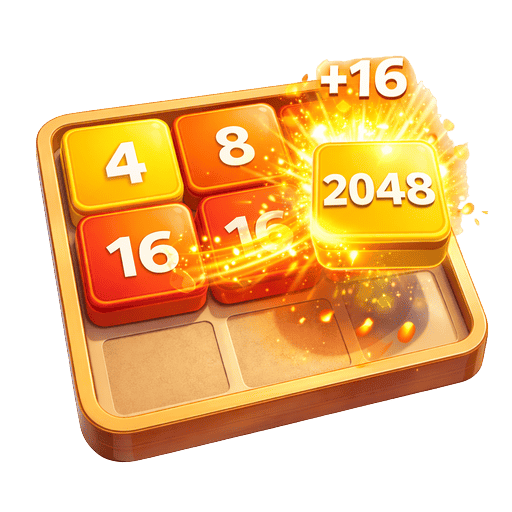
Each tile is a power of 2: 2, 4, 8, 16, 32, 64, 128, 256, 512, 1024, 2048
The grid is 4×4 = 16 cells
To reach 2048, you need at minimum 11 tiles merged perfectly (2^1 through 2^11)
New tiles are 90% chance of being 2, 10% chance of being 4
The fewer empty cells you have, the higher your risk of game over
Practice Games That Build 2048 Skills
These other Playtua games develop the same strategic thinking:
Block Blast — Spatial planning and resource optimization
Sliding Numbers — Sequential tile manipulation (directly related!)
Connect Em All — Path planning and space management
Colors Sort — Sequential constraint logic
See the full game collection or learn about Playtua's features.
Keep Reading
The Path to Mastery
Week 1: Learn the corner strategy. Focus on never swiping up. Week 2: Practice the snake pattern. Aim for 1024 consistently. Week 3: Work on double merges and recovery techniques. Week 4+: Push for 2048 regularly, then chase 4096.
The beauty of 2048 is that improvement is tangible. Every session, you'll see your average score climb higher. And the moment you first reach that golden 2048 tile — it's one of the most satisfying achievements in mobile gaming.
📱 Download Playtua — App Store · Google Play — Play 2048 with no ads, completely free and offline.
Featured Games

FAQ
What is the highest possible score in 2048?
Is there a way to always win 2048?
How long does a typical 2048 game take?
More Articles
Download Playtua Free
50+ native 3D games, minimal ads, works offline. Go ad-free with Premium!
Download NowLearn a game from its own guide.
After “2048 Strategy Guide: Pro Tips to Reach the 2048 Tile and Beyond”, explore the game guides and collections behind the stories. The dedicated game guides explain objectives, touch controls and practical tips in one place. Use them alongside the articles when you want the details for a particular game.
Penguin Run guide
Learn lane changes, jumping and sliding, then follow the goal of reaching the end of the jungle track.
ExploreBlock Blast guide
Understand block placement, line clearing and the space you need to keep open for the next shape.
ExploreCar Racing guide
Read the steering controls and learn how traffic, speed and the finish-line objective fit together.
ExploreFind a collection for your next break.
Collections group games around a style of session, from a few spare minutes to a longer offline journey. Their descriptions help you compare ideas without committing to a particular genre.
Quick-break games
Discover picks for a spare moment, with clear objectives and a range of controls and challenge levels.
ExploreOffline travel
Explore games for journeys and places where a reliable connection may be unavailable.
ExploreBrain-training picks
Browse puzzles and strategy games built around patterns, planning and making thoughtful choices.
ExploreMore stories from the collection.
Continue with a practical guide or a closer look at a way to play. These articles connect specific games with the everyday moments in which you might enjoy them.
Car Racing tips
Read ideas for handling traffic and building a more consistent run in Car Racing.
ExploreOffline games
Explore the collection’s offline side and ideas for choosing games before your next journey.
ExploreGames for families
Read the parents’ guide to choosing games from the collection and exploring them together.
ExploreOne collection on iOS and Android.
Choose your device’s store to see current compatibility, installation details and available purchase options. All games currently remain playable without a subscription; Premium badges are labels only.
App Store
Open the iOS listing to check device compatibility and install Playtua on your supported Apple device.
ExploreGoogle Play
Open the Android listing to review compatibility and installation details for your phone or tablet.
ExploreFree and Premium
Play the collection free with ads, or review the optional ad-free subscription. The purchase screen shows the current local price and billing terms.
Explore